Fountain Valley is a well-established, mostly residential city in the heart of Orange County, known for its quiet streets, strong schools, and easy access to both jobs and the coastline. With around 55,000–57,000 residents, it feels like a classic postwar suburb that has matured rather than exploded, attracting long-term homeowners, multigenerational families, and professionals who want “been-here-for-years” stability instead of constant turnover. Median household incomes are well into six figures and homeownership rates are high, which shows up in how well the homes, parks, and public spaces are maintained.
The city grew up from agricultural roots into a bedroom community and now a mixed residential-employment base with major employers like Kingston Technology, Hyundai Motor America, and D-Link anchoring local jobs. Most residents still commute to surrounding job centers, but the presence of these companies, medical offices, and retail centers means you don’t have to leave town for everyday needs. Lifestyle here is low-key and family-centric: youth sports, dog-walking in Mile Square Regional Park, school events, and weekend gatherings in neighborhood parks. The demographic mix is notably diverse, with a large Asian and Asian-American community and a significant share of foreign-born residents, which adds depth to dining, small businesses, and community organizations.

Living in Fountain Valley is largely about predictability and convenience: strong public services, low serious-crime rates by regional standards, a city government that leans into business-friendly policies (no local utility tax, efforts to attract and retain employers), and a civic culture that expects clean, orderly neighborhoods. You’re close to the beach without the tourist traffic, close to job hubs without the urban intensity, and plugged into the broader Orange County lifestyle while still coming home to a place that feels more residential than destination.
Geographically, Fountain Valley sits almost dead-center in Orange County. The city is directly north of Huntington Beach and Costa Mesa/Newport Beach, and just south of Santa Ana and Anaheim, placing it within a short drive of coastal recreation, major employment corridors, and regional attractions like Disneyland, South Coast Plaza, and the Irvine Business Complex. The city is compact—about 9 square miles—and largely built-out, with a classic grid of residential neighborhoods wrapped around commercial corridors and the enormous 600-plus-acre Mile Square Regional Park at its core.
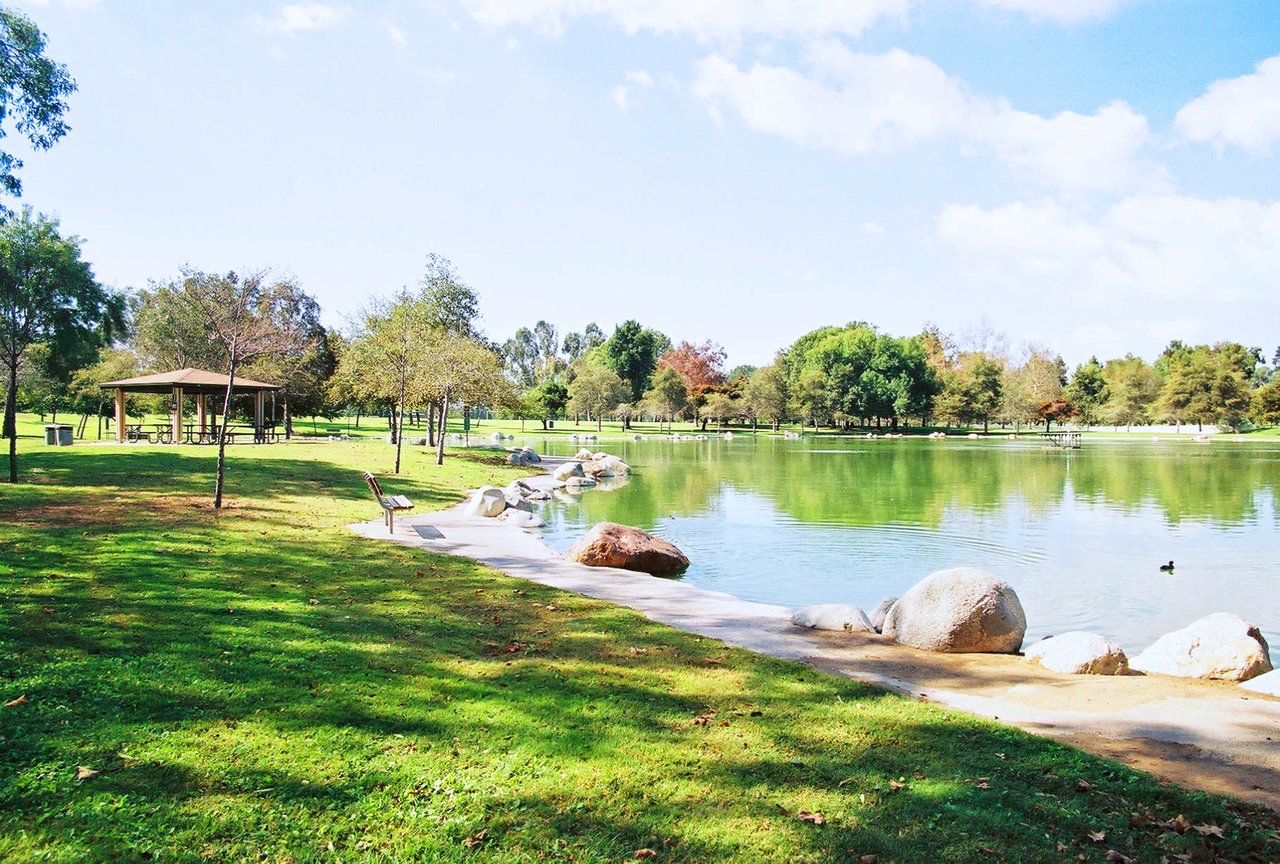
Mile Square Regional Park defines the physical and psychological center of Fountain Valley: a perfect “mile square” bordered by Edinger (north), Warner (south), Brookhurst (west), and Euclid (east). Inside are lakes, multiple 18-hole golf courses, extensive sports fields, picnic grounds, and a nature area—essentially the city’s backyard and a major everyday amenity for nearby neighborhoods. Residential tracts radiate out from this green core: single-family homes on quiet cul-de-sacs, townhome communities, and low-rise apartment complexes tucked between arterial streets like Brookhurst, Euclid, Bushard, Talbert, Warner, and Slater. Light industrial and office parks cluster near the Santa Ana River and the southern/eastern edges, where larger parcels and freeway access make sense for employers.
Getting around Fountain Valley is straightforward and car-friendly. The 405 Freeway cuts through the southern part of the city, providing direct connections west to Huntington Beach and east toward Costa Mesa, Irvine, and the broader LA/OC freeway network. Major surface streets are wide, with synchronized lights and commercial nodes at key intersections, so day-to-day errands rarely require freeway use. Public transportation is available via OCTA bus routes along main corridors, connecting Fountain Valley to neighboring cities and regional transit hubs; it’s usable for workers and students who don’t drive, though most residents rely primarily on cars.
Regional access is another quiet strength. John Wayne Airport in Santa Ana is roughly 10–15 minutes away in normal traffic, making business and leisure travel easy, while LAX is reachable via the 405 for long-haul flights. The Santa Ana River trail and nearby bike routes give cyclists and runners non-street options, and coastal cities like Huntington Beach and Newport Beach are close enough for spontaneous evening or weekend trips. In practice, the geography of Fountain Valley gives residents a rare combination in Southern California: a calm, interior residential setting with quick, direct access to both ocean and employment centers.
Fountain Valley leans hard into its motto, “A Nice Place to Live,” and it fits: the overall vibe is calm, orderly, and family-focused rather than flashy. Streets are clean, parks are busy but not crowded, and most activity centers around schools, sports fields, and community events rather than nightlife. Long-term residency is common; a city survey has previously noted residents averaging over two decades in town, which contributes to a “we’ve known our neighbors for years” feel and a strong sense of investment in how the city looks and functions.
Demographically, Fountain Valley is a mature, upper-middle-income community. The city has roughly 56k residents, with a median age around 44—older than both California and the greater LA–Orange County metro—reflecting a big share of established families and a sizable senior population. Median household income is in the low-to-mid $110k range, and educational attainment is high, with over 90% of adults having completed high school and nearly half holding a bachelor’s degree or more.
The community is also notably diverse, with a particularly large Asian and Asian-American population that shapes the city’s cultural and business landscape. Recent data show Asians making up roughly one-third of residents, with significant Vietnamese, Chinese, and Korean representation; white residents (many long-time homeowners), Hispanic/Latino families, and smaller Black and Pacific Islander communities round out the mix. This diversity shows up in multilingual signage, places of worship (churches, a synagogue, a mosque), and everyday life—from Asian supermarkets and pho shops to bakeries and family-owned restaurants scattered along major corridors.
Lifestyle here revolves around recreation, schools, and city programming more than big attractions. Mile Square Regional Park functions as the community’s living room, with residents using it for everything from weekday jogs and dog walks to youth soccer, weekend golf, family picnics, fishing, archery, and casual meetups on the extensive lawns and lakeside paths. The adjacent Fountain Valley Sports Park and community recreation center add organized leagues, classes, and programs for kids, teens, adults, and seniors, reinforcing the “active but low-key” rhythm of daily life.
Culturally, the city skews community-oriented rather than destination-driven. Annual events like Fountain Valley Summerfest—held at the sports park with carnival rides, food trucks, vendors, live music, and fireworks—serve as major social touchpoints, drawing residents from every part of town and reinforcing that “small city with big park” identity. Local schools and youth sports act as additional social glue: parents see each other on the sidelines, at back-to-school nights, and at fundraisers, creating tight-knit micro-communities around each campus.
Overall, Fountain Valley’s lifestyle is best described as stable, suburban, and quietly diverse. It’s a place where people prioritize safety, schools, parks, and everyday convenience over nightlife or trend-chasing—ideal for buyers and renters who want a settled, community-centric environment in the middle of coastal Orange County.
Fountain Valley’s housing stock is dominated by established single family neighborhoods, with most ownership housing in detached homes built from the 1960s through the 1980s, many now updated with open floor plans, larger kitchens, and modern finishes. Lots are moderate by Orange County standards, often with backyards, mature trees, and room for outdoor living.
You also see pockets of townhomes, garden homes, and low to mid rise apartment communities in R2 to R5 zones, which provide attached and multifamily options for downsizers, first time buyers, and renters who want the same central location at a lower price point. Condos and townhomes tend to transact around the 500,000 to 600,000 dollar range, while most single family homes easily clear the one million mark, which creates a clear tiered entry into the market based on budget.
The current market sits firmly in higher cost, high demand territory. Recent data show a median sale price around 1.36 to 1.4 million dollars, up roughly 2 to 8 percent year over year depending on the time window and data source, with homes typically going pending in about 21 to 36 days, faster than national norms. In late 2024 the median sale price was about 1.32 million, a jump of more than 14 percent from the prior year, underscoring a multi year appreciation trend.
Zillow’s home value index puts the typical home value around 1.32 to 1.33 million, up about 2 percent in the past year, with listings going pending in roughly three weeks, and a sale to list ratio just above 1.0 which means many homes still sell near or over asking when priced correctly. On the rental side, average monthly rent is a little over 3,100 dollars, and housing costs sit more than double the national average, which reinforces that this is an upper middle income, ownership oriented market.
People buy in Fountain Valley for a combination of stability, location, and long term value. The city offers primarily owner occupied single family neighborhoods, strong schools, and a low crime, family oriented environment, which supports resale demand in almost every cycle. At the same time, you are paying less than in coastal Newport Beach or some parts of Irvine, while still being minutes from beaches, major job centers, Mile Square Regional Park, John Wayne Airport, and the regional freeway network.
For buyers, that means paying a premium compared to many parts of the country, but gaining an asset in a supply constrained, high demand Orange County submarket with a proven appreciation record. For sellers, relatively low days on market, strong pricing, and a deep pool of move up buyers and incoming families create favorable conditions if the home is well presented and correctly priced.
Fountain Valley is a big draw for families because of its school options. The city is served by multiple districts: Fountain Valley School District (K–8), Garden Grove Unified, Ocean View School District, and Huntington Beach Union High School District, plus the Coast Community College District. Fountain Valley School District is consistently ranked among the top-performing districts in Orange County, with recognition in state and national programs such as California Distinguished and Blue Ribbon schools.
At the high school level, most students attend Fountain Valley High School, a large, well-established campus (opened 1966) known for strong academics, extensive AP offerings, and competitive athletics within the Huntington Beach Union High School District.
Nearby community colleges in the Coast Community College District (like Orange Coast College and Golden West College) offer easy access to two-year and transfer pathways.
Parks are central to daily life here. Mile Square Regional Park is the signature open space: nearly a perfect mile on each side, with lakes, walking and biking paths, two 18-hole golf courses, an archery range, sports fields, picnic shelters, and a nature area planted with California natives. It’s where residents jog before work, walk dogs in the evening, run youth sports on weekends, and host big family gatherings.
The adjacent Fountain Valley Sports Park adds lighted fields, tennis and basketball courts, playgrounds, and a large recreation center—currently slated for a 16-acre expansion to meet growing demand, signaling long-term investment in recreation infrastructure.
Beyond Mile Square, the city maintains a network of neighborhood parks and senior facilities like The Center at Founders Village, giving every age group accessible outdoor and community space.
Fountain Valley doesn’t chase “destination retail,” but it’s packed with practical and increasingly interesting options. Major shopping nodes like Fountain Valley Promenade and Fountain Valley Town Center offer grocery anchors (Ralphs, Albertsons), big-box retail (Ross, T.J. Maxx), fitness, services, and a wide mix of casual dining.
Along the main corridors—Brookhurst, Euclid, Warner, Talbert, Slater—you get everything from national chains to independent bakeries, Asian supermarkets, and Vietnamese, Korean, Japanese, and Mexican restaurants, reflecting the city’s diverse population.
Entertainment skews family-friendly: Fountain Bowl is a large, modern bowling center that also serves as a social hub with leagues, parties, and events, and Fountain Valley Skating Center offers classic roller skating fun. You’re also minutes from Huntington Beach and Costa Mesa for movie theaters, malls like South Coast Plaza, and more nightlife, so residents often pair “live in Fountain Valley, go out nearby.”
Besides Mile Square Park and the sports park, local attractions are small-scale but varied. Families visit The Reptile Zoo for a hands-on, indoor option; skaters and bowlers head to the skating center and Fountain Bowl; golfers use the Mile Square Golf Course; and walkers, birders, and casual cyclists loop the lakes and paths in the park. Hotel guests and residents alike often treat Fountain Valley as a central base for broader Orange County attractions—nearby beaches, Disneyland, the Segerstrom Center for the Arts, and coastal trails are a short drive away.
Key landmarks include Mile Square Regional Park itself, which essentially functions as the city’s “signature image,” and the Fountain Valley Recreation Center & Sports Park, the city’s main civic-recreation complex. Fountain Valley High School is another local landmark, both physically and culturally, with a large campus and visible community presence through athletics, music, and events. Commercially, centers like Fountain Valley Promenade and Town Center, as well as notable restaurants such as Nep Cafe—a widely covered Vietnamese brunch spot—serve as informal landmarks and regional draws.
Fountain Valley Summerfest is the city’s marquee annual event, held at the Sports Park. It runs over several days with live music, a community stage, carnival rides, games, food vendors, and a major fireworks show, effectively turning the park into a temporary fairground and drawing residents from across the city and neighboring communities. Through the year, the city also permits and hosts smaller festivals, charity events, and community gatherings at its parks and facilities, maintaining a steady calendar of civic activity.
Nightlife in Fountain Valley is low-key and mostly centered on restaurants, cafes, and neighborhood bars rather than clubs. Cafes—including Vietnamese coffee spots and modern brunch places like Nep Cafe—act as daytime social hubs. In the evening, residents gravitate toward casual eateries, sports bars, bowling at Fountain Bowl, and events at the skating rink, or they simply head a few minutes out to Huntington Beach, Costa Mesa, or Newport Beach for a denser bar and restaurant scene.
Overall, “living in Fountain Valley” means strong schools, serious park and recreation infrastructure, everyday convenience, and culturally diverse food—backed by easy access to the coast and regional attractions—wrapped in a quiet, suburban package.
People love Fountain Valley because it delivers what a lot of Orange County buyers want but cannot always find in one place: quiet, safety, strong schools, big park access, and central location, all in a city that still feels manageable and low key. The city leans into its long standing motto, “A Nice Place to Live,” and residents echo that description in how they talk about it, pointing to well maintained streets, a wide network of parks, and a high overall quality of life.
One of Fountain Valley’s most distinctive features is its combination of small city scale and big city access. With around 55,000 to 56,000 residents, it feels like a compact, contained community rather than a sprawling suburb, yet it sits in the geographic center of coastal Orange County, minutes from Huntington Beach, Costa Mesa, Newport Beach, and Santa Ana. That means residents can enjoy a quieter, more residential environment at home while still being close to job centers, major shopping, arts, and the beach. For many, that balance is the main selling point: you are not paying Newport pricing or dealing with tourist crowds, but you are not sacrificing proximity to the coast or regional amenities.
Mile Square Regional Park is another reason the city stands out. Very few suburban communities have a 600 plus acre regional park literally in the middle of the city, with golf courses, lakes, sports fields, archery, a nature area, and an extensive recreation center. It functions as a daily backyard for residents, not just a weekend destination, and shapes how people experience the city: morning runs around the lakes, youth soccer and baseball on the fields, casual fishing, picnics, and tournaments that bring different neighborhoods together. Reviews consistently describe it as one of the most spacious, activity rich parks in Orange County, which becomes a signature part of living here.
Fountain Valley is also valued for its stability and sense of security. Median household incomes sit around the low to mid 100,000 dollar range, homeownership rates are high, and crime rates run well below California averages, which gives families and retirees confidence about putting down roots. City documents and local profiles emphasize long average residency times and high satisfaction scores, painting a picture of a place where people move in and stay, rather than treating it as a short term step.
Culturally, people appreciate Fountain Valley’s quiet diversity. The city has a large Asian and Asian American population alongside long time white, Latino, and other communities, which shows up in its food, businesses, and community institutions rather than in tourist branding. Residents get everyday access to Vietnamese coffee and brunch spots, Asian supermarkets, family run restaurants, and a range of churches and temples, all framed by a suburban street grid and single family neighborhoods. To many locals, that mix of comfortable suburbia with authentic, everyday cultural depth is a big part of the appeal.
Finally, Fountain Valley is often described as a hidden gem: not a tourist city, not a nightlife destination, but a place where the day to day pieces of life work well. Strong schools, a dense park system, well maintained infrastructure, low unemployment, and a business base that includes major employers all contribute to a feeling that the city is stable and well run. For buyers and residents who prioritize safety, schools, parks, and convenience over flash, that combination is exactly what makes Fountain Valley feel special.
Fountain Valley is ideal for people who want a quiet, stable, suburban base in central Orange County more than they want buzz or nightlife. It fits best for move-up and long-term buyers—especially families—who care about strong schools, low crime, well-kept neighborhoods, and everyday access to big parks like Mile Square more than having a trendy zip code.
It also works well for professionals and dual-income households who need fast access to major job centers (Irvine, Costa Mesa, Santa Ana, coastal cities) and John Wayne Airport, but prefer to come home to a lower-key, residential environment with mostly owner-occupied streets. Downsizers and retirees who value safety, medical and service convenience, and flat, walkable neighborhoods also find it a comfortable fit.
Fountain Valley is generally not for those seeking urban energy, a big nightlife scene, or entry-level Southern California pricing. It’s an upper-middle-income, high-cost, but highly livable community for people who prioritize predictability, parks, and schools over flash—essentially, the “Nice Place to Live” promise delivered in everyday life.
Real estate can be complex, but with the right team, it doesn’t have to be. We’re by your side with local knowledge, honest guidance, and a passion for getting it right. Let’s turn your goals into reality!